Saint Kumaraguruparar and Sri Kasi Mutt
Sri Kasi Mutt Sri Kasi Mutt - Single Column Sri Kasi Mutt S it Kumaraswami Mutt at the Kedar Ghat Va - ranasi and Sri Kasi Mutt at Thupanandal in Tamilnadu are two of the renowned Saivite Mutts in India. Founded by or ewing their origin to Saint Ku - maraguruparar who hailed during the seventeenth century In the Southern most part of our country and rendered invaluable social and spiritual service, especially in the Gangetic region, by dint of his pro - found learning, wisdom and spiritual prowess. The name "Kasi Mutt' is significant in that it in - dicates the institution's association with the holy olty of Kasi (Varanasi) and in particular with the Kumaraswami Mutt at the Kedar Ghat founded by the Saint himself Kumaraguruparar was born about three hundred and sixty years ago at Srivaikuntam, now a small town on the Northen bank of the riv - er Thambaraparani, midway between Tirunelve - li and Tiruchendur. His parents who were Keder Ghat Nunded devotees of Lord Muruha (Kaarthik) at Tiruchendur were childless for long. Kumaragu - ruparar vas bom to them as a result of their fervent prayers to Muruha. The child did not speak until lie was about five years old. The intensive faith of the parents in the Lords grace and their contin - ued prayers to Him yielded results. At the age of five when on a visit to the shrine at Tiruchendur the child not only started speaking but also sang, extemporarily, a song of a classical type known as Kandar Kalivenba in adoration of Lord Muruha (Skanda) much to the delight of the parents and to the surprise and admiration of the devotees then as - sembled their. Kumaraguruparar thus came ot e be first known to the world at large as a born-poet and a child prodigy graced by the divinity. His was an instance of what may be termed as a climax and fru - ition of accelerated spiritual maturity and wisdom gained in former briths. May be Kumaragurugparar had passed the age of boyhood, when it is said, he took leave of his par - ents and left Srivaikundam promoted by an urge to seek and find a guru a spiritual master. Earlier, when on a visit to Tiruchendur he had heard a voice from the heavens to the effect that the person before whom his words featured, would be his guru. When proceeding on this quest, Kumaragu - ruparar first halted at Madurai, Tirumalai Nayakar was then ruling this part of Tamilnadu (as a Vassal of the kingdom of Vijayasnagar) with Madural as capital Kumaraguruparar worshipped at the great temple there and composed a cluster of poems known as PILLAI TAMIL in adoration of the god - dess Meenakshi. This composition MEENAKSHI AMMAN PILLAI TAMIL is well known for the beauty of its style rhythm and richness of import it is said that prompted by a divine call Tirumalai Nayakar con - tact Kumaraguruparar and arranged for a public ex - position of the poems in the temple. Tradition has it that in the course of the exposition, the goddess ap - peared in the guise of an young girl, graced the poet by putting a garland of pearls around his neck and then disappeared. This incident it may be remem - bered, was the second one showing that the poet was a great soul and must have come into this world with a divine mission. Needless to say that Tirum - alai Nayakar honored the Poetri a big way made his visit to Madurai a memorable one, by celebrating it verily as a festival. During his stay at Madurai Kumaraguruparar composed poetical works known as MADURAI KALMBAKKAM and MEENAKSHI AMMAI KURAM. It is said that at the request of Tirumalai Nayakar he also composed a code of ethics entitled NEETHI NERI VILAKKAM comprising of one
SAINT KUMARAGURUPARAR AND THE TWO GREAT MUTTS ASSOCIATED WITH HIM
(A Historical Sketch) 22 M 2026 M 2026 hundred and two verses.
From Madurai, Kumaraguruparar proceeded
to Tiruvarur, worshipped Lord Thiyagaraja and stayed there for sometime while at Tiruvarur, he composed a series of poems entitled TIRU V ARUR NAAN - MANI MALAI in the praise of Lord Thiyagaraja. Leaving Tiruvarur Kumaraguruparar proceed - ed to Dharmapuram. On reaching that place he ex- perienced a feeling of elation and ecstasy foretelling that something great and good was to happen to him here long. He was soon to realis his objective of finding his spiritual master, the one preordained by providence. The sanyasin who then adorned the GNAN - APEETAM of Dharmapuram Mutt was one Masi - lamani Desikar. On entering the Mutt Kumaragu - ruparar paid his respects to that sage. Desikar asked our poet if he could explain (not the literal mean - ing but) the philosophical import of a certain verse in the Peria puraanam (biographic of sixty three saivite saints) where in saint Sekkizhar its author, has adverted to the ecstasy and bliss experienced by saint Sundarar (one of the canonical four) the moment he had darsan of the Lord at Thillai (chid- ambaram) Kumaraguruparar could not readily an- swer. His words faultered remembering intuitively the heavenly voice that he heard at Tiruchendur, he realised that he was in the august presence of that very personage, his guru, preordained as such by the Lord. He immediately prostrated before Desikar and entreated that he might be taken as his disciple and given initiation. Desikar acceded to Kumaraguruparar request but desired that Kumaraguruparar should go on pil- grimage to Kasi and return as a prelude to initiation Kumaraguruparar pleaded for waiver of this condi- tion explaining the risks and delay involved in mak- ing the trip from the far south to Kasi in those days. The guru was pleased to modify the condition. He stated that Kumaraguruparar should atleast go to Chidambaram, and stay there for a MANDALAM (45 days) worship the LORD OF Thillai (chidam - baram) and then come back to him Kumara gu - ruparar agreed to do so and took leave of his guru. On his way to Chidambaram Kumaraguruparar made a brief halt at Vaitheeswarn koil, worshipped at the temple there and composed a PILLAI TAM - IL in adoration of Lord Muthukumarasami (Muru- ha) in that shrine. This visit by the saint to Vaith - eeswaran koil it is said, was in response to a divine call (by Lord Murugha). Kumaraguruparar cherished very much his stay at Chidambaram. Worshipping the lord of Thil - lai was so very delectable to him. In that frame of mind, Kumaraguruparar composed three remark - abale poetical works there known as Chidambara Mum Mani Kovai Chidambara Ceyyul Koval and SIV AKAMI AMMAI IRATTAI MANI MAALAI Guru Masilamani Desikar was immensely pleased to receive Kumaraguruparar on his return from Chidambaram. He gave him the orange - robes, the insignia of sanyasins and then gave him initiation observing the necessary formalities. Kumaragu - ruparar composed at this stage a series of poems entitled PANDAARA MUMMANI KOV AI eulo - gizing his guru. Desikar repeated his wish that Kumaragu - ruparar should visit Kasi and that there he should strive to revive the vedic religion which had been relegated to the background (due to animosity be - tween different religionists) and thus revive the cult of Saivism in the North. We may pause here and digress a little the afore- said meeting between the pontiff of Dharmapuram and Kumaraguruparar reminds us about the first meeting between Ramakrishna Paramahamsa and Vivekananda, nearly two centuries later. The for - mer was then a realised soul a gnani but the latter, though a hightly intellecutal and well read person in the ordinary sense of these terms, lacked the requisites spiritual experience, as such until then. But the fact that Vivekananda was then an aspirant and had an irrepressible yearning to know about and realise the truth, qualified hikm to receive the belessings of Ramakrishna we may draw an anal - ogy here betweenthe meeting between Kumaragu - ruparar and Masilamani Desikar on the one hand and Vivekananda and Ramakrishna on the other. 23 M 2026 We may even continue the analogy and refer to Kumaraguruparar visiting Kasi at the behest of his guru and to Vivekananda visiting America after re- ceiving the blessing of his Master. The similarities in both the cases are striking and obvious. We may now revert to our subject proper Kumaraguruparar undertook to render service as desired by his guru and took leave of him. It must have taken some months for him to reach Kasi. We may well infer the difficulties he would have experienced on the one hand experiences he would have gained on the other during that long and arduous journey.
On the eve of reaching Kasi
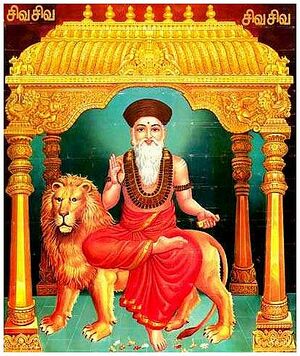
Kumaraguruparar prayed to the Goddess of learning to confer Her grace upon him. He composed in adoration of her a series of verse known as SAKA LAKALA V ALLI- MAALAI The religion of Kasi was then part of and a prov- ince in the Moghal Empire. Aurangazeb (1658-1707) was then the emperor at Delhi. Dara Shuko a brother of Arungezeb, was Badussha (ruler) at Kasi. He was a scholar and is known to have translated the Upanishads into Per- sian. It is said that he was tolerant towards other re- ligious, a rare trait in Muslim rulers. Soon after his arrival at Kasi, Kumaraguruparar would have naturally desired to meet the Badusha. Notwithstanding the genial attitude of the rules it appeared, there were practical difficulties for a Hin- du Sanyasin like him in getting admission into the palace. May be he was actually prevented by the guards from going in and having an audience with the Badusha. Whatever it was, situation powers our saint it is said got astride a lion and (it must be) without any obstruction whatever, entered the pal- ace and thus had his first audience with the Badu - sha. It may be stated in the connection that during the Mohal days, to capture a lion alive was consid - ered as rare feat and those who could accomplish this received royal patronage. Dara Shuko had then convened an interreligious conference at Kasi. Delegates representing several religions attended that conference on his invitation. This conference was in sessions when Kumaragu - ruparar setfoot at Kasi. The Badusha invited Kumaraguruparar to come and address the conference. The sage accepted the invitation and addressed the sessions. He spoke in Hindustani the language of that region. The subject of his talk was Saivism, its fundamentals, its catho - licity and universality. He explained its tenets in the light of Saiva Siddhanta, its basic philosophy. It may be stated that the sage had, in his prayer to the Goddness of learning. expressed a desire to the effect that he may be gifted withe such a power of expression as would humble even emperors. The audience which heard the sage's talk with rapt atten- tion became rapturous. What was more, the Buda - sha who was already all respect and admiration for the sage bowed to him, expressed his appreciation of his talk and declared that he could ask of him and favour he liked. It was thus evident that Kumaragu- ruparar had received the grace of the Goddness of learning in full. Kumaraguruparar told the Badusha that he may be given an abode at Kasi from where he could be enabled to propagate Saivism. The Badusah readily agreed to grant the sage's request and also gave him the option to choose a place which may be to his liking. Tradition has it, that the shrine of Kedarnath at Varanasi on the bank of the Ganga, at the site which now bears its name, (namely Kedar Ghat) was then in ruins and covered by shrubs and debris, and that Kumaraguruparar who had bydivine intutions come to know about it was then praying for the guidance of the Lord (Kedarnath) in this respect. It was then that the Badusha offered to grant him a site where - on he could construct and ASRAM and what was more left the choice of the site to the saint himself. Guided (innately) by the Lord, Kumaragu - ruparar told the Badusha that an area of land en - compassed by the flight of a kite (Garudan) which would make its appearance and fly overhead might be granted to him. The Badusha agreed accordingly Ere long. a Kite appeared in the sky as if by a mira - 24 M 2026 cle made a circular flight overhead covering a fair - ly large area which included the site on which the shrine of Kedarnath once stood and also the site whereon the (Kumaraswami) Mutt came to be built later. The Badusha made an absolute gift of those areas to our saint.
Prior to the arrival of Kumaraguruparar to Kasi
, that city was experiencing the greatest gloom. The temple of Viswanath had already been demolished due to feud and faction resulting from intolerance. Other important temple there link the Panduranga temple and the Kedarnath temple had also shared the same fate. It was against the background that Kumaraguruparar carried there the message of tolerance and love, was able to bring in peace and harmony strife -ridden society and to prove that the Hindus and Muslims could live together as good neighbours respecting each other's faith. Kumaraguruparar's good rapport with the rul - er and the ruling class and the amicable relation - ship between persons owing allegiance to differ - ent faiths, which he could effect as a result of his preaching paved the way for the renovation of Hin- du temples including those of Viswanath and Pan - durange. Thanks to the patronage extended by the Badusha, our saint could renovate the Ketharnath Temple and also built the mutt which latter came to bear his name as Kumarasamy Mutt. Kumaraguruparar, who become almost a per - manent resident of Kasi for the rest of his life is known to have visited Dharmapuram on four occa- sions and paid his respects to his guru. On one such occasion, it is said, he took with him all the money and valuables presented to him by his Bakthas at Kasi, tendered them at the feet of his guru and be - seeched him to take them for himself. But the guru declined the offer and suggested that it behooved Kumaraguruparar to take them back to Kasi and use them for the benefit of people of that regions to whom that property should rightly belong. Kumar- aguruparar obeyed and did accordingly.
Kumaraguruparar stayed at Kasi
for well-nigh thirty years (1658-1688). He gave regular discours- es of Tamil Culture its religions literature and scrip- tures. He invariably spoke in Hindustani which enabled the local people to grasp and understand clearly his expositions and what was more the sen - timents expressed by him touched their hearts. His talks reveal his profound knowledge of scriptures, both in Tamil and Sanskrit. It is said that Kumaraguruparar gave daily dis - courses in Hindi and Kamba Ramayana which were so inspiring that many devotees and scholars and among whom was the illustrious Hindi poet and saint Sri Tulasi Das attended them. After Sankara Kumaraguruparar was perhaps the next great sanya- sin who impelled by a sense of service travelled to the north of our country far away from the place of his birth in the far south, facing an overcoming ad- versities. Of these two, Sankara's sphere of work was confined to religion and philosophy, whereas Ku - maraguruparar's were not only these two but also included in the sphere of social work in a society on the verge of degeneration and disintegration due to dissensions and discord among people owing alle - giance to different faiths. In the sphere of work Ku- maraguruparar's achievements were phenomenal indeed. It may be stated that in the course of history would have been different but for the timely advent of Kumaraguruparar upon the scene and, it he had not been there, history would perhaps have record- ed a sorry version. It will be no exaggeration to say that Kumaraguruparar was a pioneer in what we have now choose to learn to National Integration. Kumaraguruparar was a spiritual giant un - equaled in his generation. He was a philosopher of rare intellectual acumen, a divine poet, a great educationist, an eminent preacher well versed not only in Tamil but in Sanskrit and Hindi as well, and, above all a leader who could by sheer force of his spiritual personality, persuade others to conform to his way of thinking and achieve the impossible. In his monumental work on the ethics - Needhi Neri villakkam - Kumaraguruparar has highlight - ed the value and importance of learning as many as nineteen out of total of one hundred and two verses nearly one fifth of it. That the saint has chosen to deal with this subject of learning so elaborately in 25 M 2026 a treatise on ethics, would suggest that in his view, learning should serve us a proper basis for shaping and regulating a morally sound society. In one of his poems dealing with learning the saint has also emphasised one's moral duty to feeding the needy.
Though the Needhi Neri Vilakkam
is generally stated to be an epitome of Tirukkural, we find that Kumaraguruparar has included there in certain en- nobling concepts as ethics which are not referred to by Thiruvalluvar. Two of the verses in Needhi Neri Vilakkam seen to have a special appeal to Gandhiji They are as fol- lows, as rendered in English by one Rev. H.Stokes. Y outh is a bubble on the water riches in full abundance are the long waves that roll the water the body is a writing on the water Why O my friends worship we not the court of our God? Contemplate those who are poorer than your - selves rejoice in the greatness of you possessions contemplate those who are more learned than yourselves, and destroy self conceit (sya aganthai) exclaiming what is all our learning to theirs. Gandhiji. it appears came to know about these verses which has he was in South Africa. He valued the sentiments expressed there in so much that he copied them in original Tamil script, for his refer - ence. In a daily issue of the Hindu about fifty years back a news item appreared giving the above in - formationj in brief and also a halftone photo print showing part of a verse the words of Kumaragu - ruparar (youth is a bubble onthe water) ( 5 ) written in Tamil by Gandhiji himself.
1688. Kumaraguruparar attained SAMADI
at Kasi onthe third day after full moonin May The Kumararaswami Mutt and the temple of Kedarnath. both associated with the memory of our saint, are now two of the important land marks at Kasi the mutt (not so much the building but the in- stitution) the spiritual centre. As such, serves as a beacon light to guide and illuminate us in the realm of ethics religions and philosophy. The saint's suc - cessors in interest the presiding sanysasins of the Mutt have all along continued to foster and carry out his noble mission through the insitutions at Kasi and Tirupanandal and their branches. The opulent and well to do admirers and follow- ers of Kumaraguruparar including rajas and nobes have during his life time and after gifted properties to the two institutions namely the Kumaraswamy Mutt at Varanasi and the Kasi Mutt at Tirupanandal to foster and carry out the ideals cherished by the saint. The following are some of the donors who have liberally contributed in this behalf. 1. Maharaja of Nepal 2. Raja Sarfogi of Thanjavur (Tamil Nadu) 3. Raja of Ramnad (Tamil Nadu) 4. Zamindar of Japalle (Andhra) 5. Rajas of Karventnagar (Andhra) 6. Raja of Kalahasthi (Andhra) The successors of Kumaraguruparar listed in the annexure have all along continued to carry out his objects Then sixth head of the mutt. Thillsainayaka Swa- mi (1720)/ established the mutt at Tirupa nandal to facilities effective administration of the properties. He continued to stay and function at Tirupanadnal and thus gave rise to a convention. His successors observed that by mostly staying at Tirupanandal and making frequent visits to Varanasi. As the mutts at Kasi Tirupanandal are virtually two divisions of one and the same institutions the - one at Tirupanadal came to be by passage of time, looked upon. treated and called as Sri Kasi Mutt consequently. The head of the two institutions, being one and the same individual came to be recognised as the head of the Sri Kasi Mutt at Tirupanandal and the Mahant of the Kumaraswamy Mutt of Varanasi Very appropriately the head of the mutt is also re - ferred to as 'Kasi vasi (resident of Kasi) 26 M 2026